The war against wilding conifers continues in Central Otago

Staff Reporter
15 February 2026, 5:00 PM
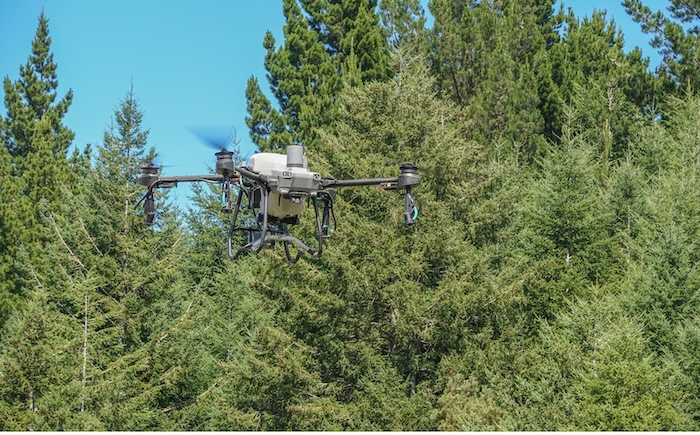 A live demonstration of spray-drone control targeting Douglas fir near Dansey Pass. Image: supplied
A recent field trip by the Central Otago Wilding Conifer Control Group (CWG), highlighted just how rapidly escalating the problem is.
Led by project manager Pete Oswald, CWG board members as well as government and forestry representatives, were taken on a 340km loop of the district to examine the scale of the wilding pines issue.
“The purpose of the trip was simple in theory, but complex in reality: to bring together forestry, farming, governance, and environmental voices to quantify and qualify a rapidly escalating ecological and economic crisis, and to begin shaping collaborative solutions to a problem that is as controversial as it is urgent,” volunteer co-ordinator Aimee Pilcher said.
At Dunstan Burn they looked over a farm where paddocks harvested from pine forest were already being reclaimed by wilding conifers.
The landowner, working with CWG, had been grappling with the sheer scale of re-investation - balancing control methods, land economics, and the visual and ecological integrity of his property.
“Discussion quickly turned to the use of drone spraying: its effectiveness, limitations, and suitability in this terrain. That conversation broadened into debate around restoring soil fertility through nitrogen-fixing species, the challenges of re-establishing grazing land, and the long-term viability of different control models. Fire was also proposed as an appropriate control method on emerging wildings.”
In Naseby they looked at a farmer’s remarkable efforts to halt wilding spread from the Naseby Forest through burning, in collaboration with the forest managers and CWG.
“CWG has also applied significant public funds to this area to ensure this frontline between the forest seed source and the Oteake conservation area is controlled to a point where the landowner can reasonable assume control on their own.”
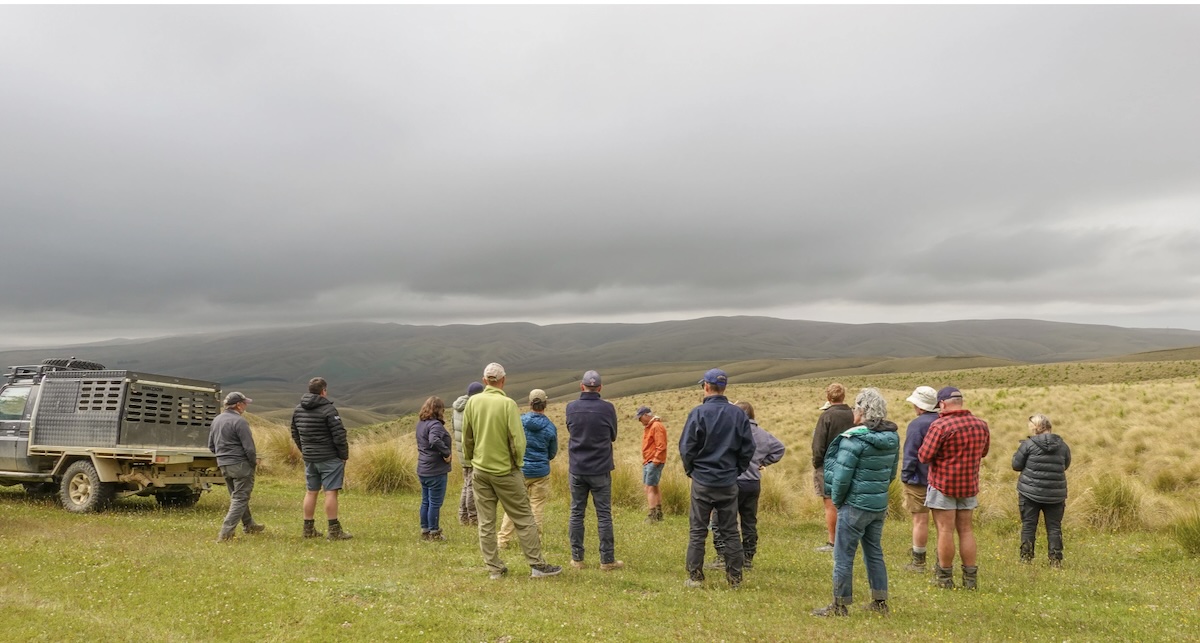
Industry representatives and Central Otago Wilding Conifer Control Group members at a recent field trip around Central Otago. Image: supplied
Aaron Watson, from Central Wilding Tree and Landcare Services, spoke about the realities of running a conifer control crew - the physical demands, the complexity of decision-making, and the constant trade-offs between terrain, infestation density, ecological impact, and financial cost.
“In this case, an area of approximately 340 hectares of medium infestation was best suited to manual clearance with chainsaws. The scale of the effort was sobering, but it powerfully reflected the farmer’s commitment to protecting both the Oteake Conservation Area and productive farmland for generations to come,” she said.
At Dansey’s Pass, they were given a live demonstration of spray-drone control targeting Douglas fir.
Aimee said for many in the group, it was a first and an eye-opening look at how rapidly control technology is evolving.
Further along the pass, a local shared his experience of trying to reclaim grassland under relentless pressure from Douglas fir spread from a long-standing seed source on a neighbouring property.
“Upwind landowners had refused to remove seed sources, leaving the farmer to shoulder the cost of land degradation, lost productivity, and ongoing control. CWG has provided significant financial support here for which the farmer was very grateful.”
The group looked at the successful control of the Kakanui Range that was carried out in 2016-17, and now not a single pine tree can be seen on the hills.
Aimee said the final stop of the day was the most confronting.
They were met by a wall of Douglas Fir forest - planted two decades ago and believed to be claiming carbon credits.
The forest is managed by PF Olsen but Waiting for the group was a neighbouring farmer, “who wasted no time expressing his anger and exhaustion as Douglas fir continued to spill into his tussock high-country land.”
Aimee said his message was direct: the burden of managing the spread should not fall on neighbouring farmers who never consented to conifers in the first place.
Carbon credits, he argued, must not come at the cost of ecological collapse and economic loss for others.
“It was a heated exchange - uncomfortable, raw, and necessary.”
She said seeing the issue firsthand reinforced both the scale of the problem and the value of collaboration in tackling it.
“A solution to wilding conifers will not come from any single perspective, but days like this move us meaningfully closer to shared understanding and workable solutions.”
Have a story to share or comment to make? Contact editor@centralapp.nz
NEWS