Pharmac seeking clinical advice on funding Wegovy weight loss medication

RNZ
17 January 2026, 5:21 PM
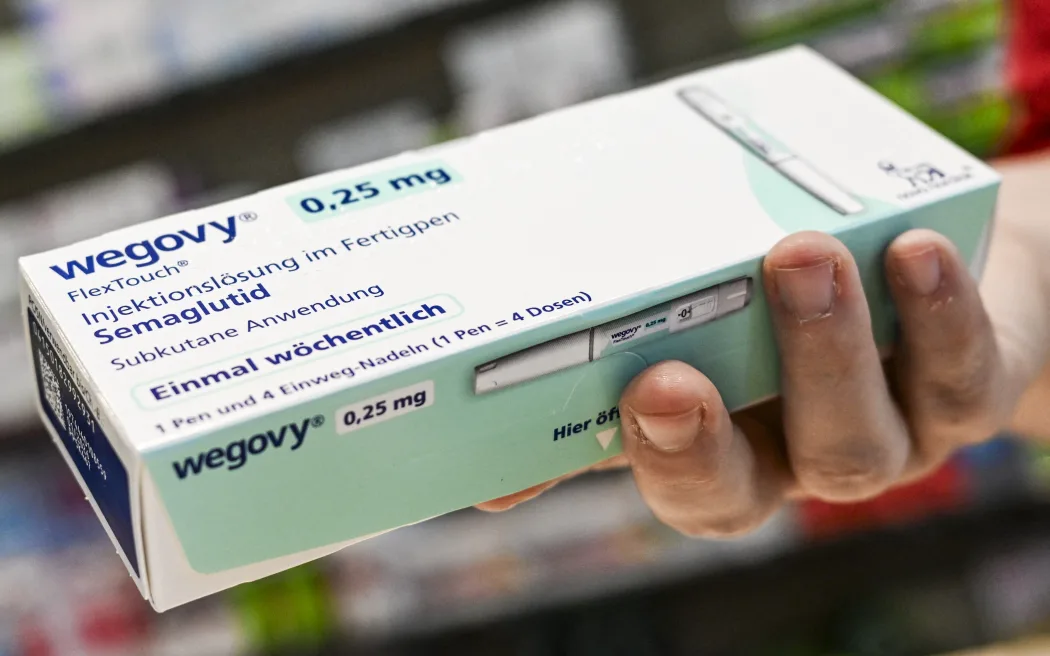 Wegovy slimming medication at a pharmacy in Berlin. Photo: AFP / Jens Kalaene
Pharmac is seeking clinical advice on whether weight loss medication should be funded.
New Zealand has the third-highest adult obesity rate in the Organisation for Economic Co-operation and Development (OECD).
One in three people over the age of 15 are classified as obese and one in eight children aged between 2-14.
Pharmac received two applications to fund Wegovy or semaglutide - a GLP-1 receptor agonist for weight loss.
The first was in September, for people with an established cardiovascular disease (such as someone who has had a heart attack or stroke) and a Body Mass Index (BMI) of 27 or higher. The second
was in October, for chronic weight management in people with a BMI of 30 or higher, with at least one weight-related comorbidity.
Pharmac director of advice and assessment David Hughes said guidance was expected to be published later this month.
"Our expert advisors will assess how effective the medicine is compared with current funded options, and consider its impact on individuals, whānau, caregivers and the wider health system," he said.
Hughes added that Pharmac also had an application to fund Saxenda or liraglutide for people with very high BMI.
That application was currently under assessment.
On Monday, Australia announced that Wegovy would be subsidised, after being listed on the country's equivalent to Pharmac.
The ABC reported that Australia's Health Minister Mark Butler committed to listing the drug on the Pharmaceutical Benefits Scheme for patients with an established cardiovascular disease and a BMI of
35 or higher. No clear timeline for was established.
However, that would reduce the cost to AU$25 (NZ$29) per script or AU$7.70 (NZ$9) for a concession card holder.
Wegovy costs $459.99 per month in New Zealand.
Associate Minister of Health David Seymour could not comment on what Pharmac should or should not fund.
"However, I am urging them to improve their budget bids for more money, by considering how funding new drugs might save the taxpayer money elsewhere," he said.
"That shift could lead to drugs such as this one being funded sooner, but the final decision remains with Pharmac."
Weight loss specialist Dr Gerard McQuinlan also believed that funding Wegovy would save the taxpayer money in the long run.
He told RNZ that obesity was related to more than 200 other diseases.
"If I just take one of them, like diabetes, the risk for developing Type 2 diabetes if you have obesity is about 12 times, right?
"If you look at the cost of Type 2 diabetes to the taxpayer - this is from the Ministry of Health - it costs about $2.1 billion per year, so just reducing just one disease, like diabetes, you can save a lot of
money."
He did not think funding Wegovy would create a shortage, especially once the pill form was available in New Zealand.
He said obesity was a chronic, relapsing and progressive disease, with a 95 percent chance the weight would return, if the disease was not managed through medication.
"We don't want people to lose weight and then stop the medication, and the weight comes back on, because usually, they'll gain more weight than what they started with," he said.
"People put on more weight after dieting, eventually, because it's not a willpower problem - it's a hormone problem. It's to do with hormones that regulate hunger, appetite and particularly the feeling that
people have had enough food.
"That's the problem with obesity - people don't feel that they've eaten enough. The signal's lost.
"The Wegovy, that is the hormone that controls satiety, the feeling that you've had enough to eat."
NEWS

JOBS